
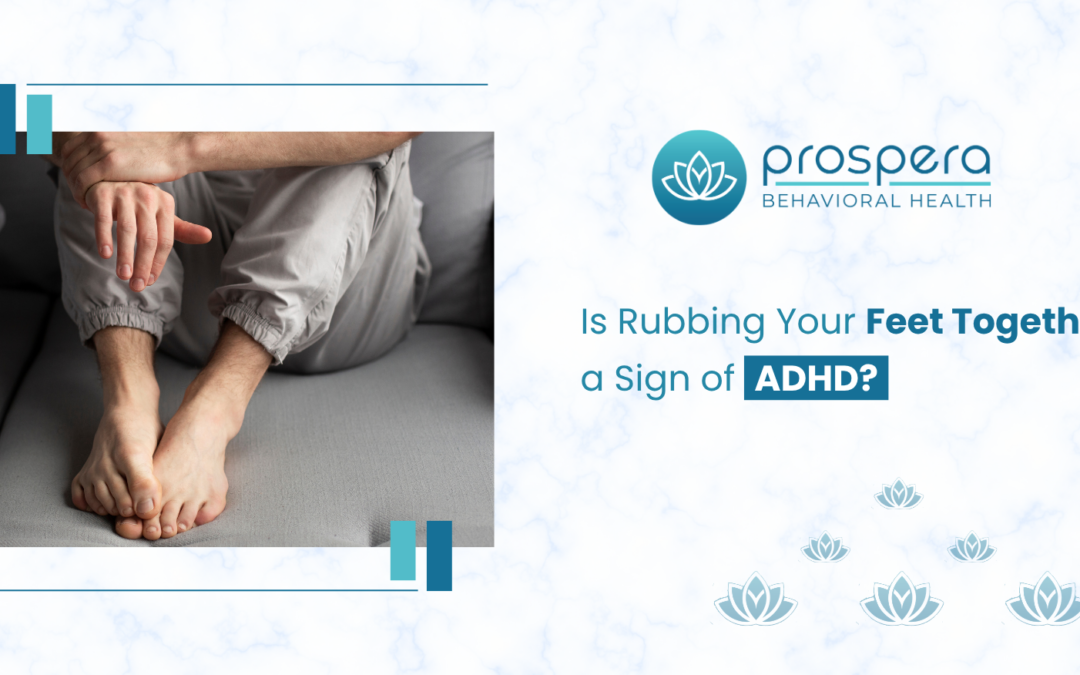
You may not have even realized you were doing it.
Maybe someone pointed it out. Perhaps last night you found yourself in mid-motion, feet together in that slow, practiced rhythmic way at bed, and thought, “Where does this even come from?”
The Brain That Cannot Idle
ADHD is not simply about attention. That is the version of it most people learned, but it leaves out a lot.
One of the things it leaves out is this: the ADHD brain does not regulate its own stimulation levels the way other brains do. The dopamine system, which manages focus, motivation, and that sense of reward for effort, runs differently. And when it is not getting what it needs, the brain goes looking.
Not deliberately. Not consciously. It just starts reaching for input wherever it can find it.
Endless repetitive movement is one of its methods to achieve that. Rubbing your feet together creates a constant flow of sensory input to the brain.
That tiny physical loop from the foot (or fingers or both) is often what enables many of us with ADHD to sit still and listen, or even sleep.
What This Kind of Movement Is Called
Stimming. Short for self-stimulatory behavior.
It covers a wide range of things. Foot rubbing, leg bouncing, pen clicking, hair twirling, knuckle cracking, rocking, picking at skin. Different people, different outlets, same underlying function.
It is not exclusive to ADHD. Anxiety, autism, and sensory processing differences all produce it too. But in ADHD it has a particular purpose, regulation, and it tends to show up wherever the brain feels under-stimulated or overwhelmed.
Feet are a popular spot for a pretty practical reason. They are almost always accessible. Under a desk, under a blanket, in a meeting, during a phone call. Small enough movement to go unnoticed. Enough sensation to do the job.
Why Bedtime Is When It Gets Loud
This is something a lot of people mention. The foot rubbing is worse at night.
During the day there is structure: tasks, deadlines, conversations, noise. The brain has things to hold on to. The moment you lie down and all of that drops away, the ADHD brain does not wind down the way it is supposed to. It accelerates. The quiet is not restful. It is empty, and an empty space is an ADHD brain’s least favorite thing.
So the feet start moving. It is the nervous system reaching for something small and rhythmic to hold onto while everything else is supposed to go still. Not a disorder. Not a weird habit. A coping mechanism that developed because something needed to.
Kids Do It Openly. Adults Do It Quietly.
Watch a child with ADHD in a classroom and the movement is hard to miss. Feet rubbing under the chair, chair rocking, pencil tapping, collar chewing, and constantly repositioning. Teachers sometimes read it as restlessness or attitude. More often it is the opposite. The child is moving because moving is what is keeping them in the room mentally.
Pull the movement away and the focus usually goes with it.
Physical habits that tend to show up in kids with ADHD:
- Rubbing feet together while seated or at bedtime
- Rocking in the chair rather than sitting flat
- Chewing on pencils, collars, sleeves, anything nearby
- Tapping that never fully stops
- Needing to stand, walk around, or lie on the floor to think
- Fidgeting with whatever the hands can reach
Adults are a different story. Most people with ADHD have spent years absorbing the message that their movement is disruptive, immature, or rude. So they learn to suppress it in public. They sit still. They keep it contained.
But the need does not disappear. It goes underground.
Where it tends to surface in adults:
- Feet rubbing together in bed or while working
- Leg bouncing kept low so nobody notices
- Pen clicking that they stop the moment someone looks
- Scrolling a phone on a loop as a sensory substitute
- Doodling through every meeting and phone call
- Needing something playing in the background to get anything done
- Picking at nails or skin without any memory of starting
Most adults with undiagnosed ADHD have filed all of this under personality. Just how they are. The restless one. The fidgety one. The one who cannot watch a movie without doing something else at the same time.
Sometimes that framing is the only one they have ever been given.
It Is Not Always ADHD Though
Worth being straight about this.
Restless leg syndrome moves at night too, often feet and legs specifically. The difference is that restless leg comes with a physical sensation underneath it, a crawling, tingling, uncomfortable urge that the movement temporarily relieves. ADHD-related stimming is less about physical discomfort and more about sensory regulation. They can look the same from the outside but they feel different from the inside and they have different causes.
Anxiety produces repetitive movement as well. When the nervous system is running hot it looks for discharge, and physical habits are one of the ways it finds it. ADHD and anxiety also overlap significantly in a lot of people, so the picture is not always clean.
And sometimes a habit is just a habit. One behavior without context does not tell you much.
The Pattern Is What Matters
Foot rubbing alone is not a reason to book an evaluation. But foot rubbing as part of a larger pattern is a different conversation.
Things worth paying attention to:
- Starting tasks is hard even when you actually want to do them
- Finishing is its own entirely separate battle
- You lose things, miss things, forget things consistently despite genuinely trying not to
- Sitting through long conversations or meetings without drifting takes serious effort
- Emotions move fast, frustration, boredom, excitement, and they hit harder than they seem to for other people
- Sleep is difficult because the brain will not slow down when the lights go off
- You have always needed movement or noise to think clearly
- People have told you your whole life that you are capable but inconsistent
These are not personal shortcomings. They are a profile. And profiles have explanations.
What a Real Evaluation Involves
Not a checklist. Not a fifteen-minute appointment. A proper ADHD evaluation looks at history across multiple areas of life, how things have shown up over time, what else might be in the picture, and what is actually going on cognitively.
This matters because ADHD rarely travels alone. Anxiety, depression, and learning differences all overlap with it regularly. Treating one piece while missing the others is how people end up feeling like treatment helped a little but not enough.
A thorough evaluation gives you an accurate picture. That picture is what everything else gets built on.
If You Are in Houston
Prospera Behavioral Health offers psychological evaluations for ADHD in children, teens, and adults, alongside therapy for people who already have a diagnosis and want support that actually moves the needle.
If you have spent years wondering whether your brain works differently, or watching your child struggle in ways that feel uncomfortably familiar, clarity is available. You do not have to keep guessing.
The foot rubbing got you here. Let it lead somewhere.
Reach out to Prospera Behavioral Health to book your consultation.
Visit prospera-bh.com