
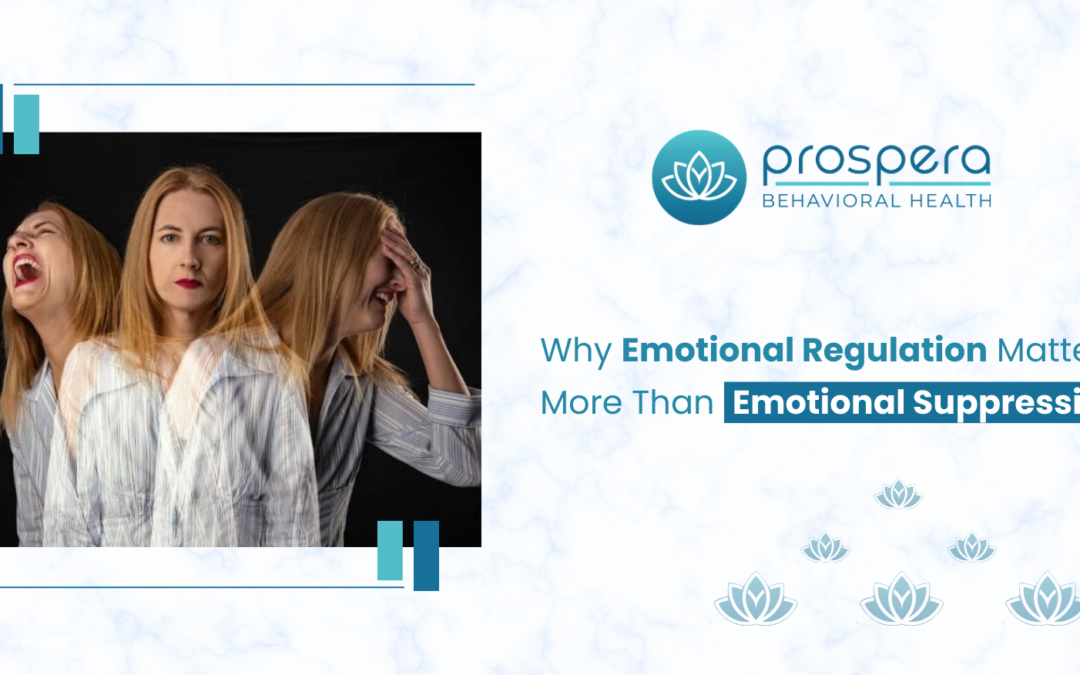
The vast majority of people do not receive any formal training in the management of their feelings.
Often we are told to calm down, ignore it, or not make it a big deal.
The action of pushing feelings down is called emotional suppression. While people frequently feel in control of their feelings, the reality is that emotional suppression is actually the opposite.
What Is The Difference?
At first glance, suppression and regulation might actually seem like the same thing.
With both, there is management of feelings/emotions.
However, there are large differences in how these two methods deal with feelings/emotions!
Emotional Suppression
Suppression is a form of expressive inhibition, and understanding the suppressing emotions meaning starts here.
You feel the emotions, but you block the outward expression. You also block your internal acknowledgment of the emotion.
Emotional suppression does not decrease emotional responses.
In fact, it does the opposite, and it actually causes more emotional responses to occur, and your body’s nervous system continues to respond.
Common signs of habitual suppression include:
- Saying “I’m fine” often
- Feeling emotionally disconnected or numb (dissociation)
- Unexplained physical tension, headaches, or fatigue
- An emotional outburst that seems overly disproportionate to the cause
- Struggling to describe or identify what you’re feeling (alexithymia)
It’s also worth understanding repression vs suppression: repression is unconscious, while suppression is a conscious choice to push feelings aside – and both carry long-term consequences.
Emotional Regulation
Emotional regulation describes a larger set of conscious, adaptive strategies to manage the intensity, duration, and expression of an emotional experience.Emotional regulation is not about eliminating emotion. It is acceptance and working together with the emotion.
Some strategies that are effective for emotional regulation include:
- Cognitive intervention: Reframing the scenario or situation without ignoring it
- Mindful awareness: Observing the emotion without judgment, and without avoidance
- Distress tolerance: Developing a temporary emotional discomfort capacity
- Interoceptive awareness: Early emotional alertness and self-synthesis before the situation
The objective is not to feel less. The objective is to respond with intention.
Why Suppression Backfires
Suppression is often viewed as a short-term problem-solving strategy, and to the same extent, some of it is true; you can survive the meeting, dinner, or conversation.
Suppression, like most survival strategies, has far more complex and complicated second and third-order consequences.
Chronic suppression is linked to:
- Increased physiologic stress responses and cortisol
- Increased risk of anxiety and depressive disorders
- Less social connectedness – when an emotion is suppressed, others are emotionally unavailable to them, so people tend to avoid them
- Reduced cognition – suppression, particularly emotional suppression, is highly cognitively demanding and uses up the executive resources required to think
- Increased trauma avoidance – suppression of affect reinforces fear pathways and avoids processing trauma
Suppression is the opposite of resolving emotional distress; in fact, it is delaying the resolution of the emotional distress and compounding the problem.
What Does Emotional Regulation Actually Look Like in Real Life?
Can you control your feelings? Regulation doesn’t mean you have to go first run a marathon, go to a meditation retreat or make a significant life change.
It’s actually really easy, and you’ll probably do it multiple times a day.
In Your Body
Start to notice the physical sensations that occur just before an emotion escalates. A tight chest before you become anxious and your anxiety turns into a panic attack.
A tight jaw before you get so frustrated that you start to get really angry.
These sensations happen before the emotion escalates and they give you the opportunity to intervene before the emotion escalates further.
Get up, put your body into motion, do the thing, and climb your way out of that pit.
In Your Thinking
How to process difficult emotions?
Cognitive reappraisal is simply noticing that your view of the situation is making things worse and, instead of continuing to repeat the same thoughts, shifting your perspective.
Don’t just think of the situation in some positive way, but give an honest perspective and a real view of the situation. That is true cognitive regulation.
In Your Behavior
Regulation can involve: taking a moment to respond, stating the feeling aloud (e.g., “I feel overwhelmed”), or choosing to step back – not to avoid the situation, but to come back with a better mindset.
You Can Learn This – It’s Not a Fixed Trait
Most people overlook the fact that emotional regulation, unlike the majority of psychological processes, can be learned, and, most importantly, it can be practiced and improved.
This is the foundation of several psychotherapies that have received empirical validation, including, for example:
- Dialectical Behavior Therapy
- Acceptance and Commitment Therapy
- Cognitive Behavior Therapy
Talk to A Licensed Therapist
At Prospera Behavioral Health, our individual and group therapies teach emotional regulation skills for real-life stress.
Our licensed clinicians use evidence-based methods and tailor the approach to your current situation.
Book a free consultation today.
Common Queries
Are there situations where it is okay to suppress feelings?
Use of certain short-term suppression techniques, such as staying calm in a professional setting is okay.
The concern is that it may become automatic suppression as a response in all areas of someone’s life.
What is the time frame for someone to notice changes in their ability to manage their feelings better?
The time frames differ for everyone; however, most individuals notice a change after some months of consistent work in skills practice or therapy.
Could the inability to manage feelings point to a greater underlying issue?
Absolutely. Emotional dysregulation is often connected to:
- ADHD
- PTSD
- BPD
- Anxiety
For a comprehensive answer, a psychological assessment is necessary.